

A lot of our clients come to us as startups or emerging growth companies with a name and a dream. One company came to us with four decades of story. They are one of the largest office movers and office furniture dealers in the country and a business everyone in this industry looks up to.
Mature, successful companies like this are a different challenge. Nothing is broken. The question is bigger: how do you make a brand that’s already won work even harder?
The Build
When we were hired in 2019, the mandate was to shore up their brand identity. We started with a ground-up refresh: a new brand strategy, new positioning, complete brand guidelines, retooled websites, content, social, and more.
The Launch
About two years ago, we sat down with the CEO and made a decision together: it was time to make the assets we built generate ROI. Three months later, we shifted from brand building to demand generation and built a program that targets their ideal customers across eight channels at once. When eight channels fire simultaneously, activity compounds, and you see it in the revenue reports.
Here’s an overview of our marketing engine.
Channel 1: Top-of-funnel cold email. We send millions of messages to carefully built lists of ideal customer profiles, engineered for one goal: landing in the inbox, not the promotions or spam tab. Emails stay under 200 words. No links. Spam trigger words removed. Every message is customized to the recipient and reads like a message from a friend, with a strong call to action. Positive responses, meeting sets, and form fills started coming in fast.
Channel 2: Visitor identification and enrichment. We de-anonymize website traffic, enrich visitor data, and run AI agents we built to match the top 1% of all web traffic against the company’s ideal customer profile. We route the best-fit prospects straight to the client’s sales team for follow-up and nurture.
Channel 3: SEO and AEO. With our SEO partner, we’re building highly optimized content, backlinks, and local SEO programs so the showrooms stay prominent in local search and Google Maps, and we’ve invested heavily in answer engine optimization (AEO).
Channel 4: LinkedIn Automation. We built an ideal customer profile inside LinkedIn and connect their team to thousands of prospective buyers. No boilerplate pitch two seconds after the connection request. We build community and trust first, because the connection opens the door to real one-to-one conversation.
Channel 5: Social media. We position our client as a thought leader and post consistently to land in LinkedIn feeds. We focus on insightful content about what matters most to their followers.
Channel 6: AI chatbots. These are not your typical frustrating chatbots. We trained them with enormous operational knowledge, so they operate like a customer service rep trained for months and with 10 years of experience. They are trained to act as a sales agent, act naturally in conversation, and pass the lead to a human.
On the furniture side, they’re also product experts: our AI agents query the inventory database every 15 minutes as products come online, so a visitor can ask what’s in stock and get an immediate answer with product images and link recommendations.
Channel 7: Customer email marketing. Thought leadership goes to an opt-in list of existing customers, kept deliberately separate from the other channels and written for people who are already customers.
Channel 8: PR. With our PR partner, the company’s philanthropic work and community involvement reach local media: interviews, local news, community stories. We also pitch those stories to local news outlets, media award shows, and industry events. It all compounds.
The Channel Audit: Knowing When to Kill the Weakest Performer
There was originally a ninth channel: print. For the first 9 months, we automated sending printed mailers that drove traffic to custom landing pages, with email follow-up. Print is a wonderful medium, and it performed.
But…
When you run this many channels, you audit them and look hard at what each costs to produce. All nine were producing. Channel 9 cost roughly five times as much as the other channels, so we eliminated it. Part of running a demand engine is the discipline to shut down the weakest channel, even when you enjoy producing the work product.
The Real Challenge: Attributing 8 Channels to Revenue
The big question is: where does the business actually come from?
Many companies answer some of the revenue question with a CRM, whether it’s HubSpot, Salesforce, or other systems on the market. This company doesn’t run any of them. And they don’t need to. For over four decades, they’ve built their own proprietary system, the envy of their industry, and their entire operation runs on it. The point is, don’t fix what’s not broken.
Instead, our team built custom APIs that feed into their proprietary system. We worked with their team to define how the data gets reported. The result: a custom attribution system that shows the entire customer journey, including lifetime value from the top of the funnel to revenue.
This type of attribution is where many struggle. Our system runs in real time, updates daily, and moves the funnel and revenue together.
It’s still a work in progress, and we’re improving every day. Next up is real-time attribution for top-of-funnel, showroom walk-ins, Google Maps direction requests, inbound calls, and other touchpoints that lead to real revenue. We are still in the process of uncovering even more revenue from our system.
The Only Metric That Matters
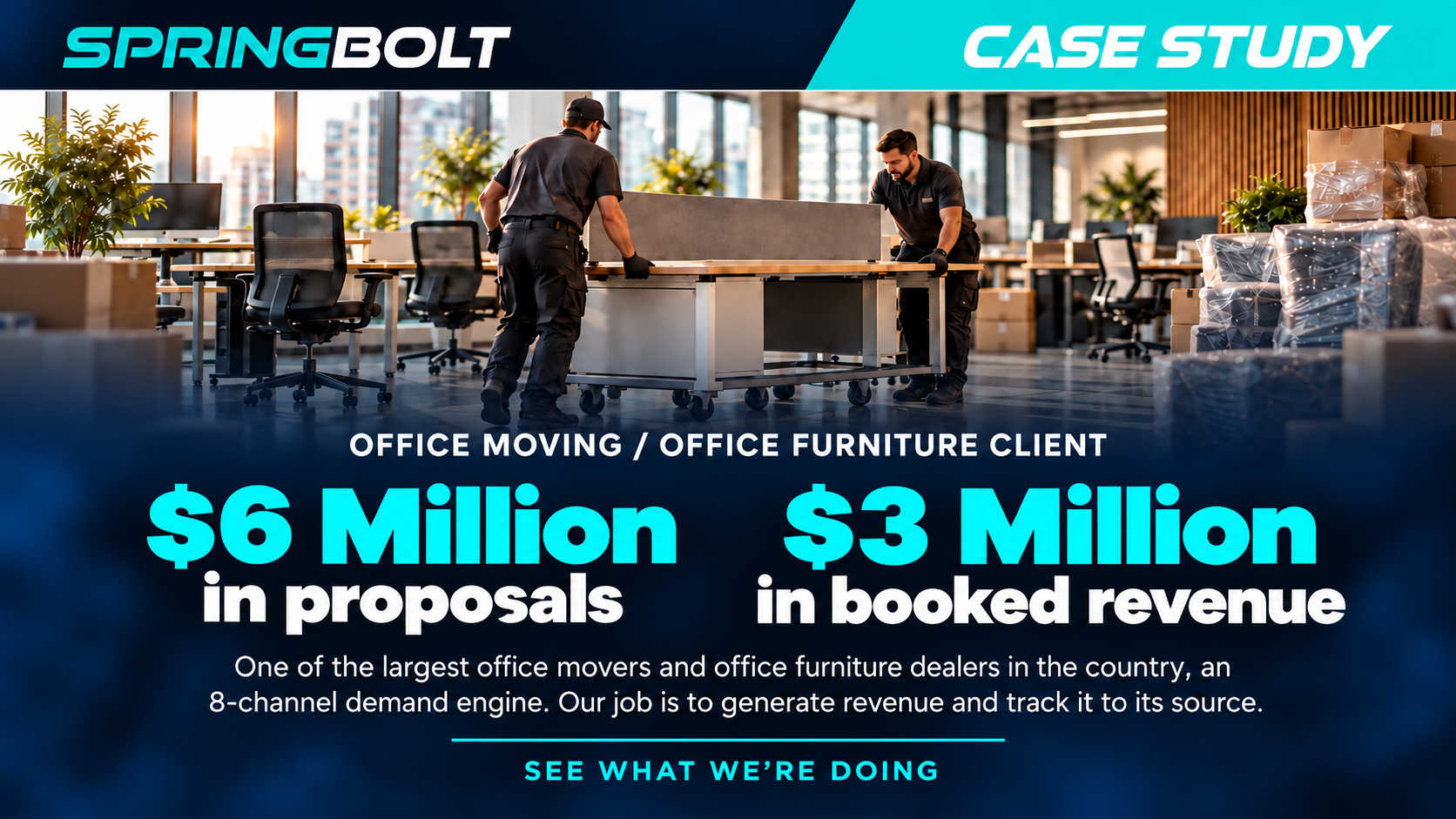
Since we launched our program, the attribution system has tracked $6 million in proposals. $3 million in booked revenue.
The bigger picture: the company’s revenue has grown 20% since the program began. For a company this mature, that kind of growth is pretty excellent. We can’t take credit for all of it, and we wouldn’t try because it takes a village to get here. This company has always been successful, and all we have done is add to a robust bottom line. We’re happy to take some of the credit.
People always wonder what a program like this costs. Here’s what we’ll say in public. By its nature, it doesn’t require a massive influx of media dollars. No giant ad budget sits behind these numbers, so we can run the entire engine at a shockingly low and reasonable cost. Want to know more? Just contact us.
Clients want to know their marketing spend is working. The most valuable thing an agency can build is the ability to prove it.