

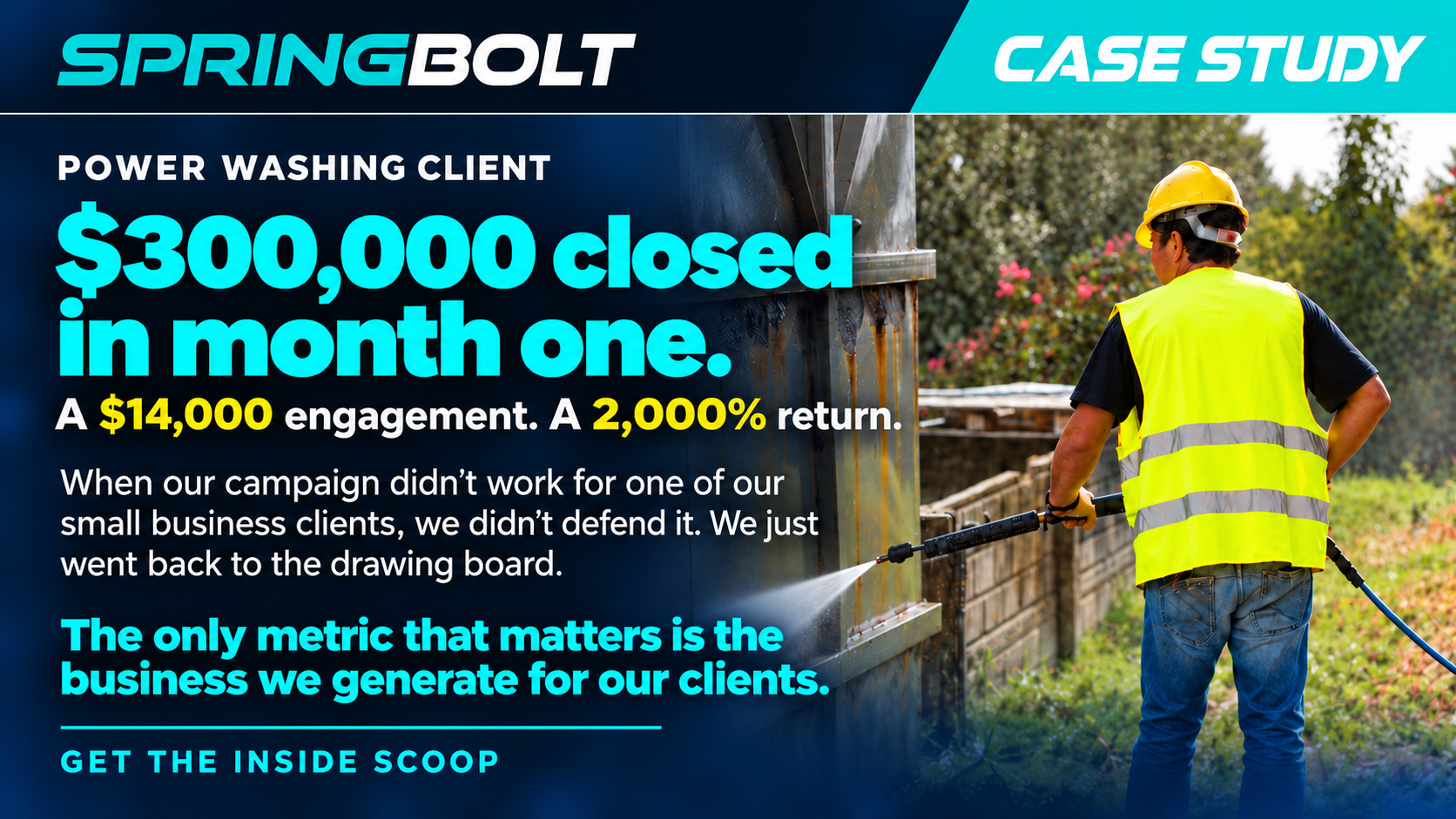
Our goal was straightforward: build the brand identity for a small power washing company and set up a demand generation system to bring them more leads. The engagement was a four-month contract, $14,000 total.
It was a small contract. We took it because we really wanted to help, and because we believed our original strategy would work. Little did we know that by month two, we’d have to rethink our strategy and start over.
At the end of month four, the client called to tell us they’d closed $300,000 in sales in August alone. That’s a 2,000% return on their investment. Not pipeline. Closed deals. Money in the bank.
Most case studies leave out the part where the first plan fails. This one doesn’t. This is the whole story, including the fail.
The Client
This is a small business going after enterprise-level clients. They work with many different customers, but the growth opportunity is in the big ones: large properties, big companies, and franchises. The kind of work that runs at commercial scale.
Historically, the business had grown on a handful of those enterprise clients. Our job was to grow that number.
Month One: The Build
The first month of the engagement ran on two tracks.
Track one was the brand. We built their identity, a website, sharpened their positioning, and produced the content and assets they need to be taken seriously by enterprise buyers. When a facilities director at a national franchise looks you up, you get one chance to look like a company they can trust.
Track two was the infrastructure. We acquired domains for a cold email program, set up the send infrastructure, and warmed up hundreds of emails with the sole purpose of landing in people’s inbox, not the promotions or spam tab. This is a service we run constantly and have been very successful with, and our setup process is the main reason it works.
Month Two: The Launch
With the foundation in place, we launched the campaigns. We delivered 100,000 emails to a carefully built list of ideal customer profiles, including facilities managers, property managers, business owners, and restaurant owners.
The infrastructure did its job. The messages landed. And then we watched the numbers and faced a truth.
When you launch a highly targeted campaign to a hundred thousand property managers, facilities directors, and business owners about a service as commoditized as power washing, you’re competing with everybody’s fifty-dollar guy, and we learned that the hard way. Everyone already knows somebody with a pressure washer. For enterprise-scale work, we were reaching the right job titles with the wrong strategy.
Two months in, with two months to go, it became clear: figure something out fast or get fired. Our best bet was to pivot and start over. If a strategy isn’t working, we’re the first to admit it.
Month Three: The Pivot
In month three, we delivered a new strategy and set up the plan: stop going one-to-one and go one-to-many.
Instead of chasing individual buyers, we rebuilt their digital footprint so the right buyers find them. We doubled our efforts and optimized their website to show up heavily in AI search overviews. We ran citation work focused tightly on Dallas, so local search points to them everywhere it matters.
We built a prioritized strategy to get them in front of trade shows, events, organizations, and platforms that hire enterprise power washing, putting them in front of a captive audience instead of an inbox.
We built it as a launch playbook, designed to scale in any city they expand to next.
The Call
At the end of August, the client called. They had closed $300,000 in new business, with another $100,000 in the pipeline expected to close once the walkthrough happened.
Then came the part that made us realize our impact: they asked us to turn down the dial on the demand engine. The explosion of business we created meant they needed to hire more people to handle it, and that’s a good problem to have.
The Only Metric That Matters
A $14,000 investment. $300,000 closed in a single month. A 2,000% return.
At Springbolt, this is the only metric that matters to us: how much money we generated for our client. Impressions, opens, and clicks are commentary. Revenue is the report card.
And the lesson inside the number is just as valuable. The original strategy didn’t fail because the execution was bad. It failed because the market context was wrong, and the only way to know that was to run it, watch it, and move fast when the data spoke. That willingness to admit defeat and fix it is why the engagement is working.
The story continues.