

This one is uncomfortable to publish from inside an agency, because the economics described here are our own.
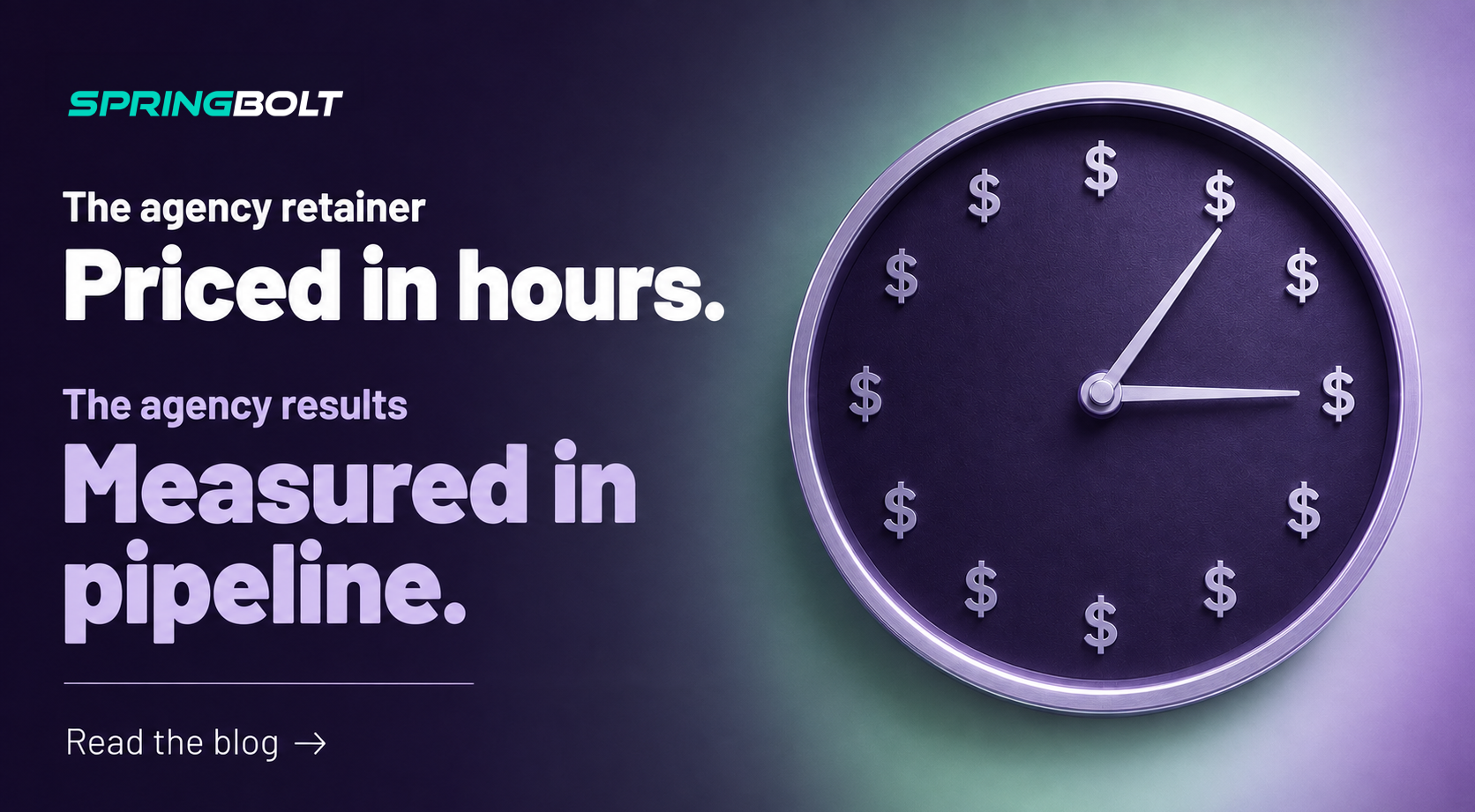
For most of the last thirty years, marketing services were priced on effort. Hours, headcount, scope. That model worked because effort correlated with output. Ten writers produced roughly ten writers’ worth of content. The correlation held for decades and nobody had reason to question it.
That correlation broke, and the pricing hasn’t caught up. For a CMO or marketing director, that gap used to be the agency’s problem. It’s becoming yours, and it’s worth understanding before the next renewal.
What the numbers say about the agency model
Worldwide ad spending grew 8.6 percent year over year in 2025, according to eMarketer. Over the same period, holding company revenues fell 1.2 percent.
Read that twice. The market for marketing grew by nearly nine percent, and the firms that serve that market lost revenue. That’s a structural problem, not a cyclical one.
Forrester puts numbers to the consequence. After an average 8 percent headcount reduction across agencies in 2025, Forrester forecasts a 15 percent reduction in agency jobs for 2026. The stated drivers include low-margin project engagements replacing retainer fees, two decades of client-side insourcing, procurement pressure, and automation disrupting a labor-based economic model.
None of that’s a prediction. It already happened.
Why your CFO is asking harder questions
Finance has read the same coverage marketing has. They know AI collapsed the cost of producing a blog post, a display set, a landing page variant. So when an invoice arrives priced the way it was priced in 2019, the obvious question follows. If this got faster and cheaper, why did the price not move?
It’s a fair question and it deserves a straight answer.
Execution genuinely got cheaper. Drafting, resizing, variant production, and basic reporting, the work that used to occupy junior staff, now runs largely through tools. What didn’t get cheaper is deciding what to make, judging whether it’s any good, and knowing whether the number it moved was real. That’s judgment work, and judgment has always been senior work.
So the honest position isn’t that nothing changed. The mix changed. Marketing organizations should be paying less for production and more for direction, and if the agreement doesn’t reflect that, somebody is on the wrong side of the trade.
Five questions to ask before your next renewal
Ask what portion of the scope is production versus strategy, and ask for it in writing. If the answer is vague, that vagueness is where the margin lives.
Ask how AI is being used on the account. Not whether. Specifically where in the process, and who reviews the output before it reaches you. An agency that can’t answer this cleanly either isn’t using it or isn’t willing to say.
Ask who owns the work if the engagement ends. Creative files, ad accounts, data, site code, and any custom workflows or trained assets built on your brand. This has always mattered and it matters more now, because a system trained on your brand voice is a real asset and ownership should be explicit in writing.
Ask what the monthly report proves. A list of twelve blog posts published and four campaigns run is an activity log. It looks like accountability and isn’t.
And watch for one specific thing. Gartner predicts that half of agencies’ proprietary AI platforms will be obsolete by 2029. If an agency is selling their custom platform as a core reason to sign, ask what happens when the underlying models move past it.
The trade most agencies haven’t made
The direction is clear enough. Pricing moves toward outcomes: pipeline, qualified leads, revenue contribution. That shift is uncomfortable for agencies because it requires confidence in their own results and the data infrastructure to prove attribution. Many shops have neither.
But it aligns incentives properly for the first time in a long while. When an agency’s revenue depends on client results rather than client hours, the conversation changes character entirely.
That’s a harder way to be measured. It’s also the only version of this business that survives the next five years.
Sources
eMarketer, 2025 (worldwide ad spending growth of 8.6% year over year against a 1.2% decline in holding company revenue).
Forrester, Predictions 2026 for marketing agencies (8% average agency headcount reduction in 2025; forecast 15% reduction in agency jobs in 2026).
Gartner, 2026 (forecast that half of agencies’ proprietary AI platforms will be obsolete by 2029).
About Springbolt Group
Springbolt Group is a full-service, AI-driven marketing, creative, and data agency. The team handles brand strategy, creative and storytelling, and data, including third-party data brokerage, for clients ranging from founder-led startups to enterprise brands. For CMOs and marketing directors trying to move faster without lowering the bar, that’s the problem Springbolt works on every day. More at springboltgroup.com.
About the Author
Raul Varela is Executive Creative Director at Springbolt Group. He entered the business in 1991 as a traditional art director, back when campaigns started with pencil sketches. Today he leads the creative work at Springbolt Group. Across three decades he’s helped launch hundreds of companies for clients, from small businesses to Fortune 100 brands, and founded several of his own.
He was a co-founder of PICKUP, the enterprise last-mile delivery platform, where he helped take the company through Series A and Series B rounds totaling roughly $40 million, scale to 90 markets covering half the country, and sign contracts with most of the major big-and-bulky retailers in the United States. The company was later acquired by Point Pickup.
He’s taught at the university level for over a decade across several North Texas institutions, and is currently an adjunct professor at East Texas A&M, where he teaches UI/UX design and entrepreneurship courses in the master’s program.