

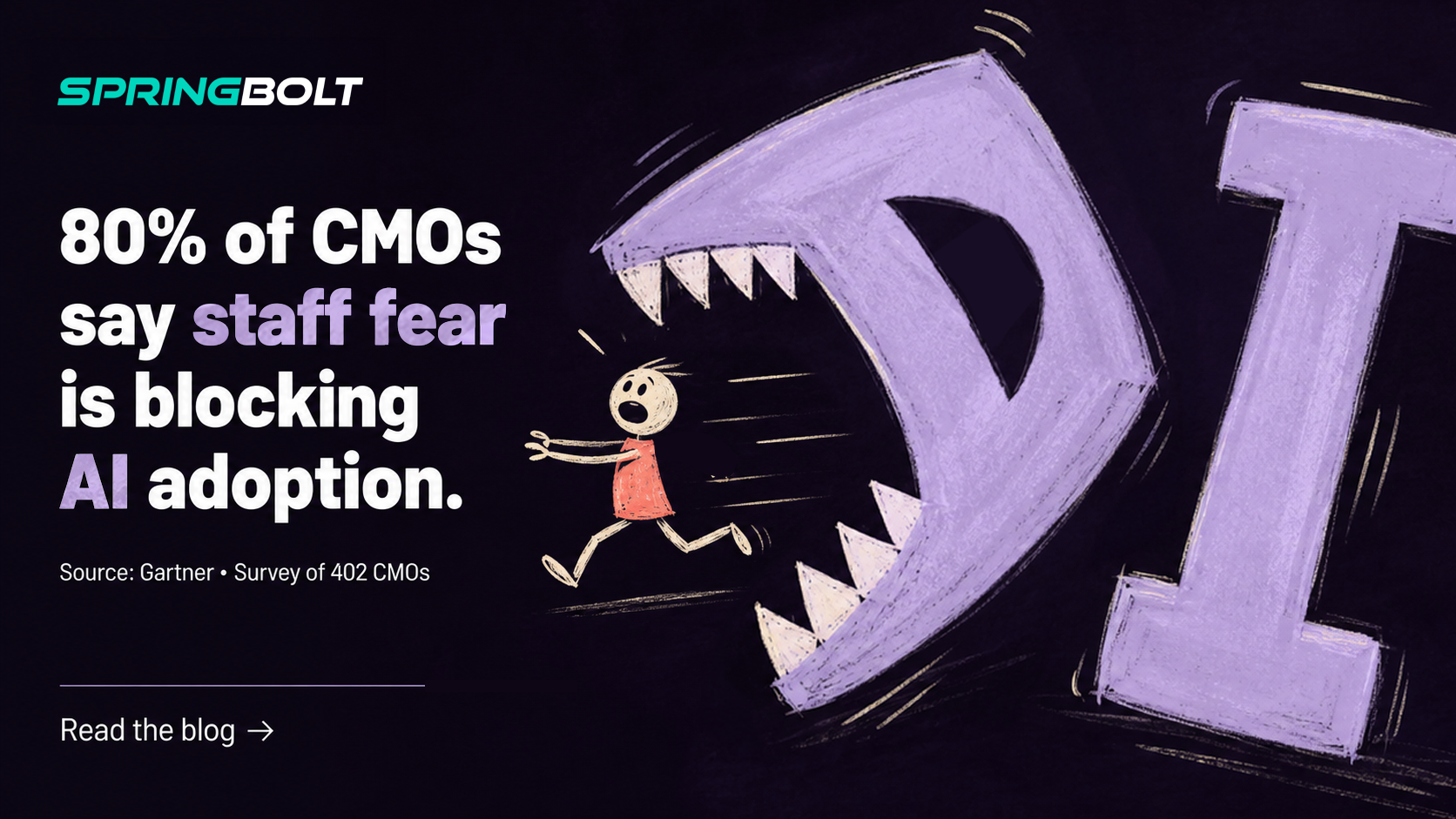
Gartner surveyed 402 CMOs and found that 80 percent say staff fear and anxiety is a barrier to AI experimentation.
Sit with that. Four out of five marketing leaders report that the thing slowing them down isn’t budget, not tooling, not the technology. It’s a room full of people who believe they’re being phased out.
This is worth discussing honestly rather than through a change management framework, because most of those frameworks skip the part that actually matters.
The fear isn’t irrational
The first mistake leaders make is treating this as a communication problem, as though the right all-hands deck would fix it. It won’t, because the team isn’t confused. They’re reading the same headlines leadership is, and many of those headlines are about replacement.
The second mistake is subtler. When a twenty-year copywriter hears that AI will handle drafting, what registers is that the thing they spent two decades getting good at no longer has value. That’s not a misunderstanding. That’s a reasonable inference from how most companies have framed this.
What they need to hear is the opposite, and it happens to be true. A model can produce a draft. It can’t decide whether the draft is right for this client, this quarter, this audience. It doesn’t know the founder won’t use the word partnership. It doesn’t know which competitor just filed suit. Everything that makes a piece correct instead of merely competent still lives with the person, and their judgment is now the scarce input rather than their typing speed.
The gap in the data that should worry you
There’s a companion finding from Gartner that may be the more dangerous one. Sixty-five percent of marketers expect AI to change their jobs. Only 32 percent believe they need to update their skills.
Read those side by side. Two thirds see the change coming. One third think it requires anything of them personally. Gartner calls this the AI blind spot, and it’s a harder problem than fear, because fear at least produces motion.
Gartner also predicts that by 2027, a lack of AI literacy will rank among the top three reasons CMOs are replaced at large enterprises. That’s no longer a skills conversation. It’s a tenure conversation, and it applies to marketing leadership as much as to the team.
What works, and what doesn’t
Leading with efficiency doesn’t work. Framing AI as a way to do the same work with fewer hours prompts every person in the room to do the obvious math about headcount. That’s a rational response, not a defensive one.
Making adoption optional while implying it isn’t doesn’t work either. It puts people in an impossible position and damages trust that takes a long time to rebuild.
Starting with the work nobody is proud of does work. List hygiene, tagging, formatting, reporting pulls. Nobody built a career on those, and nobody defends them. Trust gets earned on the boring half before anything goes near work someone takes pride in.
Setting a floor rather than a ceiling works. Stop asking people to become experts and define a minimum instead. Everyone should be able to brief a model properly and evaluate what comes back. That’s a much smaller ask, achievable in a few weeks, and it doesn’t read as a demand for career reinvention.
Being specific about what stays human works. Vague reassurance makes it worse. Naming the exact decisions that remain theirs makes it real.
And a warning from experience. Moving faster than a team can absorb costs people, including good ones who would have come along with a longer runway and a gentler on-ramp. That loss is avoidable, and it’s the part most worth planning for.
The number that reframes the whole thing
If one figure from this is worth carrying into the next team meeting, it’s this. Labor’s share of the marketing budget rose from 21.9 percent in 2025 to 24.5 percent in 2026, per Gartner. Everyone predicted AI would shrink people costs. It grew them.
Gartner’s own read is that AI value depends on people, skills, and execution rather than technology alone, and that role redesign requires far more organizational effort than layoffs or hiring. The organizations getting real returns aren’t the ones that cut. They’re the ones that rebuilt what their people do.
That number can be handed directly to a team. It’s the most credible thing a leader can say to a room full of people who think they’re being phased out, because it isn’t reassurance. It’s evidence.
The bottleneck was never the technology. It was a leadership conversation nobody wanted to have.
Sources
Gartner, survey of 402 CMOs conducted August to October 2025 (80% cite staff fear and anxiety as a barrier to AI experimentation).
Gartner, February 2026 (65% expect role disruption; 32% say significant skill changes are needed; AI literacy forecast among top three reasons CMOs are replaced by 2027).
Gartner, June 2026 release and AI in Marketing guidance (labor share of marketing budget 21.9% to 24.5%; role redesign effort).
About Springbolt Group
Springbolt Group is a full-service, AI-driven marketing, creative, and data agency. The team handles brand strategy, creative and storytelling, and data, including third-party data brokerage, for clients ranging from founder-led startups to enterprise brands. For CMOs and marketing directors trying to move faster without lowering the bar, that’s the problem Springbolt works on every day. More at springboltgroup.com.
About the Author
Raul Varela is Executive Creative Director at Springbolt Group. He entered the business in 1991 as a traditional art director, back when campaigns started with pencil sketches. Today he leads the creative work at Springbolt Group. Across three decades he’s helped launch hundreds of companies for clients, from small businesses to Fortune 100 brands, and founded several of his own.
He was a co-founder of PICKUP, the enterprise last-mile delivery platform, where he helped take the company through Series A and Series B rounds totaling roughly $40 million, scale to 90 markets covering half the country, and sign contracts with most of the major big-and-bulky retailers in the United States. The company was later acquired by Point Pickup.
He’s taught at the university level for over a decade across several North Texas institutions, and is currently an adjunct professor at East Texas A&M, where he teaches UI/UX design and entrepreneurship courses in the master’s program.